Interactive self-study course · A1–C2
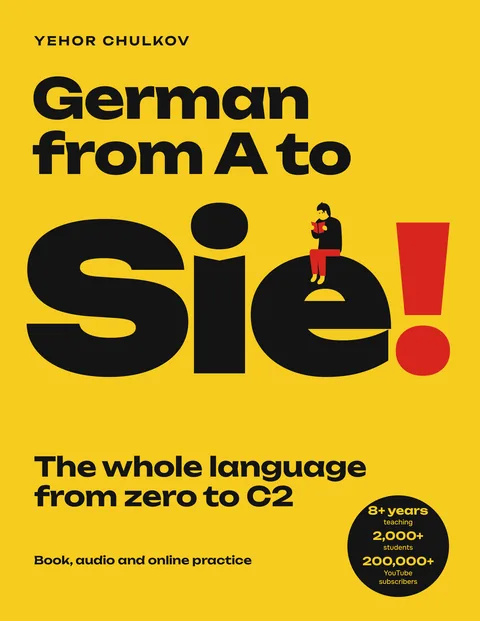
German from A to Sie!
For English speakers, in plain English
- 60 clear lessons with exercises
- Online practice that checks your answers
- Checkpoints and answers with explanations
- A chat helper for every lesson
 Yehor Chulkov 8+ years teaching German · 200,000+ subscribers on YouTube
PDF and EPUB · download right after you pay, the link also comes by email
By buying, you accept the Terms & Conditions and the withdrawal policy · seller: Link (Stripe)1More than a textbook
This self-study course has everything you need to learn German on your own, all the way to C2: the lessons, online exercises with automatic checking, checkpoints with every answer explained, audio, and a chat helper you can ask in any lesson.

- Book60 lessons from A1 to C2, with explanations and exercises
- Online practiceExercises for every lesson, checked automatically, so you see right away where the mistake is
- CheckpointsOne after each part, with every answer explained
- AudioThe dialogues and words of every lesson, to listen to and repeat
- FlashcardsThe words of every lesson on the platform, for review
- Chat helperAsk a question about the lesson, and it explains it again in different words
- SupportIf something doesn’t work, write to me and I’ll help
2What’s inside

60 lessons in six parts
Up to B1, you build the foundation: articles, cases, tenses. From B2 on, you learn to read contracts and academic texts and to get the jokes.

6 checkpoints
Each part ends with a checkpoint: listening, reading, and writing, as on a real exam. From B2 on, a speaking self-check is added.
Answers with explanations
Answers to every exercise, each with an explanation of why it’s right.

Lesson vocabulary
Nouns come with their article and plural, verbs with their principal parts, and every word has its IPA transcription and an English translation.

Audio
The dialogues and drills are recorded, and each character has their own voice. The recordings are in the lesson’s module on the platform.

Online practice
Every lesson and checkpoint has a module on the platform: audio, word cards, and exercises that aren’t in the book.
3How I explain
Everything I’ve worked out over years of teaching went into this book: explanations that make sense the first time, and exercises that make a rule stick.
Every rule starts with a situation and with why you need it; the table comes after. English is your support along the way, and short boxes show where it helps and where it trips you up. Here’s one of each kind:
Trap for English speakers
ich will looks like “I will,” but it means “I want.” So *Ich will morgen kommen. doesn’t say “I’ll come tomorrow.” For plans, German uses the plain present: Ich komme morgen.
False friends
bekommen means “to get, to receive,” not “to become”; for “become,” German says werden. And also means “so” or “therefore”; English “also” is auch.
German in English
“Apple” and der Apfel aren’t a loan but cognates: English p often matches German pf, as in “pound” and Pfund. “Kindergarten” is a real loan, from German der Kindergarten, “children’s garden.”
Austria and Switzerland
In eastern Austria, a tomato is der Paradeiser; in Switzerland, a carrot is das Rüebli. In Germany you’d say die Tomate and die Karotte.
4Nice to meet you

5Who this book is for
- 1
Complete beginners
Start with lesson 1. It begins with sounds and letters, so you don’t need to know anything beforehand.
- 2
If you started once and stopped
Take the checkpoint of the part that looks familiar. Your mistakes will show you which lesson to pick up from.
- 3
If you want to go past B1
Start with lesson 31, where part 4 begins. There you learn to choose the wording for the situation, from a letter to your boss to a chat with a friend.
What the book can’t replace
It can’t replace a conversation partner: you need to speak with real people. And C2 doesn’t mean “like a native speaker”; a slight accent may stay.

6The book has six parts
For example: Articles and the Accusative · Modal Verbs · Negation: nicht and kein
Result: you can hold a basic everyday conversation
- 1Sounds and Letters
- 2Getting Acquainted: Pronouns, sein, du, and Sie
- 3The Present Tense and haben
- 4Numbers, Time, Prices, Dates
- 5Gender and Plural
- 6Articles and the Accusative
- 7Word Order and Questions
- 8Negation: nicht and kein
- 9Modal Verbs
- 10Verbs with Prefixes and man
- KCheckpoint A1
For example: Perfekt · Reflexive Verbs · Adjective Endings
Result: you can talk about the past and get by in a store or on the street
- 11The Dative: Articles, Pronouns, Verbs
- 12Possessive Determiners, dieser, and welcher
- 13Perfekt
- 14Where and When: Prepositions
- 15Two-Way Prepositions and Positional Verbs
- 16Reflexive Verbs
- 17The Imperative and Particles
- 18Conjunctions and Subordinate Clauses
- 19Adjective Endings
- 20Comparison and gern, lieber, am liebsten
- KCheckpoint A2
For example: The Passive · Relative Clauses · The Future and the Verb werden
Result: you can handle everyday errands and write letters and messages
- 21Talking About the Past: Präteritum and the Past Perfect
- 22The Future and the Verb werden
- 23Konjunktiv II: Wishes, Advice, Polite Requests
- 24The Genitive and Weak Nouns
- 25Verbs with Prepositions
- 26Relative Clauses
- 27Indirect Questions and Two-Part Conjunctions
- 28Infinitive Clauses
- 29The Passive
- 30Word Order: TeKaMoLo and lassen
- KFinal checkpoint B1
For example: Indirect Speech: Konjunktiv I · Official Letters and Calls: Register at Work and with Agencies
Result: you can argue for your opinion and handle business correspondence
- 31Advanced Konjunktiv II: als ob, fast hätte, zu…, als dass
- 32Three Verbs at the End: The Double Infinitive, Vorfeld, and Nachfeld
- 33Guesses and Hearsay: Subjective Modals and the Future Perfect
- 34Participles Before a Noun: The Extended Adjective Construction
- 35Indirect Speech: Konjunktiv I
- 36Particles in Conversation: ja, doch, denn, halt, eben
- 37Passive Without werden: sich lassen, sein + zu, -bar, bekommen
- 38Word Formation: Nouns and Adjectives
- 39Prefixes with Character: durch-, über-, um-, unter-
- 40Fixed Phrases: Light Verb Constructions
- 41Harder Connectors: sodass, indem, falls, es sei denn
- 42Official Letters and Calls: Register at Work and with Agencies
- KCheckpoint B2
For example: German in Austria and Switzerland · Idioms and Proverbs · Colloquial German: How People Really Talk
Result: you can read academic and business texts and negotiate at work
- 43Nominal Style: When a Noun Replaces a Clause
- 44Academic Texts: The Gerundive, Participle Phrases, and Hedging
- 45Other People’s Words: Quotation, Paraphrase, and Summary
- 46Figures, Charts, Trends
- 47Making an Argument: Concession, Contrast, Conclusion
- 48Colloquial German: How People Really Talk
- 49German in Austria and Switzerland
- 50Idioms and Proverbs
- 51Career: Job Interviews, Negotiations, the Arbeitszeugnis
- 52Cohesive Text: es, Back-References, and Information Order
- KCheckpoint C1
For example: The Language of Contracts and Agencies · Literary Texts: Reading and Reviewing
Result: you can express your thoughts freely and precisely in almost any situation
- 53One Thought, Five Forms: Paraphrasing
- 54Shades of Meaning: Synonyms, Connotations, Register
- 55Style: Rhythm, Emphasis, Rhetorical Devices
- 56Literary Texts: Reading and Reviewing
- 57The Language of Contracts and Agencies
- 58Mediation: Between German and English
- 59Humor, Irony, Wordplay
- 60Speeches: A Talk, a Toast, a Farewell
- KFinal checkpoint C2
Online practice after every lesson
66 modules, one for each lesson and checkpoint, open from a QR code in the book. The email you get after you buy explains how to sign in.
Access
Online practice comes with the book: the course opens for the email address you use at checkout.

7Formats and price
Right after you pay, a page opens where you can download the PDF and the EPUB. The link also comes by email, so you can get back to the files later. If a file won’t open, write to me at info@deutsch-mit-yehor.com. Ebook buyers get corrected files free of charge: the links in the purchase email always lead to the latest version.
| Formats | PDF and EPUB |
| Levels | A1 to C2 |
| Lessons | 60 and 6 checkpoints |
| Online practice | 66 modules |
| Explanations | in American English |
The book is sold by Link, Stripe’s payment service. Link takes the payment, sends the receipt, and works out any VAT or sales tax, which is already included in the price.
8Questions and answers
Can I study on my own, starting from zero?
Yes. If you get stuck, open the answer key at the back of the book: every answer there comes with an explanation.
Do I have to go all the way to C2?
No. In my experience, B1 is enough for everyday life for most people, and that’s the first three parts. The other three are German for work, study, and the finer points of style: when you need them, you’ll already have them.
Will the book prepare me for an exam?
For the grammar and vocabulary of levels A1 to C2, yes; for the exam itself, only partly: the book has no timed tasks. In the closing chapter, I describe which certificate is usually needed for citizenship in Germany, Austria, and Switzerland and for university study in Germany. Requirements change, so check them with the agency or the university before your exam.
How does the book show pronunciation?
With IPA symbols in square brackets, for example schön [ʃøːn], because English spelling can’t show German ü, ö, ch, and r exactly. I explain how to read the symbols before lesson 1, and lesson 1 has all of them with examples. The dialogues and drills also have audio.
Is the German in the book from Germany or from Austria?
The base is the German of Germany: the book’s characters live in Cologne. Words and forms from Austria and Switzerland are in the “Austria and Switzerland” box, which appears in almost every lesson, and lesson 49 is all about German in those two countries.
PDF or EPUB?
You get both files. The PDF follows the book’s layout, in color, with bookmarks and links. The EPUB adapts to the screen of your phone or e-reader, and every exercise in it links to its answer.